
大秦帝国
China-Laos Railway trade value tops $2.97 billion in 7 months as cargo categories expand to 3,900_我的网站

A | WASHINGTON -- The Supreme Court on Monday ordered two internet sellers of gun parts to comply with a Biden administration regulation aimed at ghost guns, firearms that are difficult to trace because they lack serial numbers.The court had intervened once before, by a 5-4 vote in August, to keep the regulation in effect after it had been invalidated by a lower court. No justice dissented publicly from Monday's order, which followed a ruling from a federal judge in Texas that exempted the two companies, Blackhawk Manufacturing Group and Defense Distributed, from having to abide by the regulation of ghost gun kits.Other makers of gun parts also had been seeking similar court orders, the administration told the Supreme Court in a filing.“Absent relief from this Court, therefore, untraceable ghost guns will remain widely available to anyone with a computer and a credit card — no background check required,” Solicitor General Elizabeth Prelogar, the administration's top Supreme Court lawyer, wrote. The regulation changed the definition of a firearm under federal law to include unfinished parts, like the frame of a handgun or the receiver of a long gun, so they can be tracked more easily. Those parts must be licensed and include serial numbers. Manufacturers must also run background checks before a sale — as they do with other commercially made firearms. The requirement applies regardless of how the firearm was made, meaning it includes ghost guns made from individual parts or kits or by 3D printers.The regulation will be in effect while the administration appeals the judge's ruling to the 5th U.S. Circuit Court of Appeals in New Orleans — and potentially the Supreme Court.。
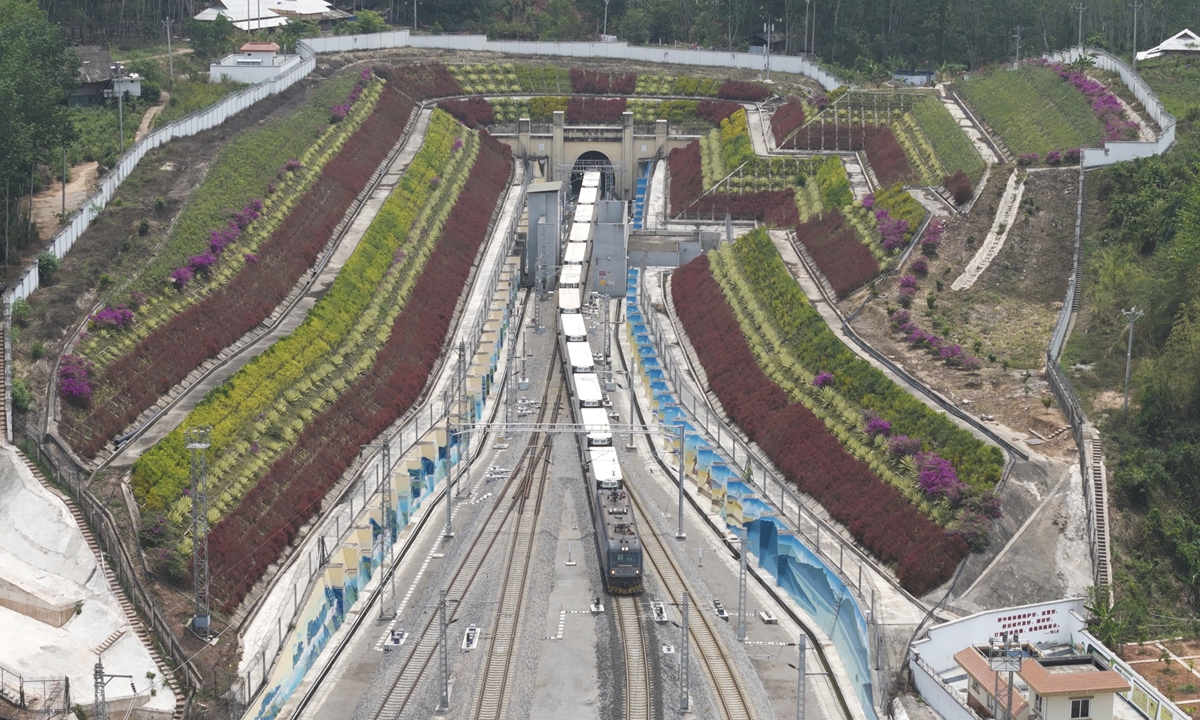
Trade via the China-Laos Railway surpassed 20 billion yuan ($2.96 billion) in the first seven months of the year, up 29.9 percent year-on-year, customs data showed. The infrastructure project is further expanding its spillover effects on trade and cooperation among ASEAN members.
As the railway continues to serve as a new engine for regional economic connectivity, the cross-border infrastructure project is expanding its cargo portfolio and injecting fresh momentum into trade and development across ASEAN economies, Chinese analysts said.
Since its launch in 2021, the railway has handled more than 94 billion yuan worth of cross-border cargo, with the range of transported goods expanding from more than 10 categories at the initial stage of operation to more than 3,900, including new-energy vehicles (NEVs), tropical fruits, temperate vegetables and traditional Chinese medicine.
The line connects 19 countries and regions and provides sustained momentum for regional trade cooperation, the data showed.
To date, the China-Laos Railway has served more than 7,000 foreign trade operators in China.
In recent months, as ASEAN members enter the peak season for fruit exports via the China-Laos Railway, agricultural products from countries along the route are gaining wider access to the Chinese market, while advanced Chinese industrial products are emerging as new drivers of cross-border trade growth, with the cargo mix continuously evolving to better meet market demand.
In the first half of 2026, imports of tropical fruits via the China-Laos Railway totaled 4.22 billion yuan, up 25.8 percent year-on-year, according to customs data cited by the Xinhua News Agency on July 22.
Foreign trade of NEVs, lithium batteries and photovoltaic products via the railway totaled 2.14 billion yuan in the first half of 2026, up 348.5 percent year-on-year, emerging as a new highlight of cross-border trade growth, the report showed.
The continued expansion of cargo categories reflects the transformation of the corridor from a single-purpose cross-border transport route into a key link connecting regional industrial chains.
The differentiated two-way trade structure reflects the complementary strengths of economies along the route, matching their resource advantages and industrial needs, Bian Yongzu, executive deputy editor-in-chief of Modernization of Management magazine, told the Global Times.
"Combined with multimodal transport services and streamlined customs measures, the China-Laos Railway has evolved beyond a cross-border transport route into a practical platform for resource complementarity, industrial coordination, and greater connectivity among Lancang-Mekong countries," Bian added.
Global Times
。
Current article:http://pobianbenmailuntiraoeng.cfd/list_61u4fh/ehop7jv.html
Published on:03:28:43
 伐木累
伐木累 刺客信条
刺客信条